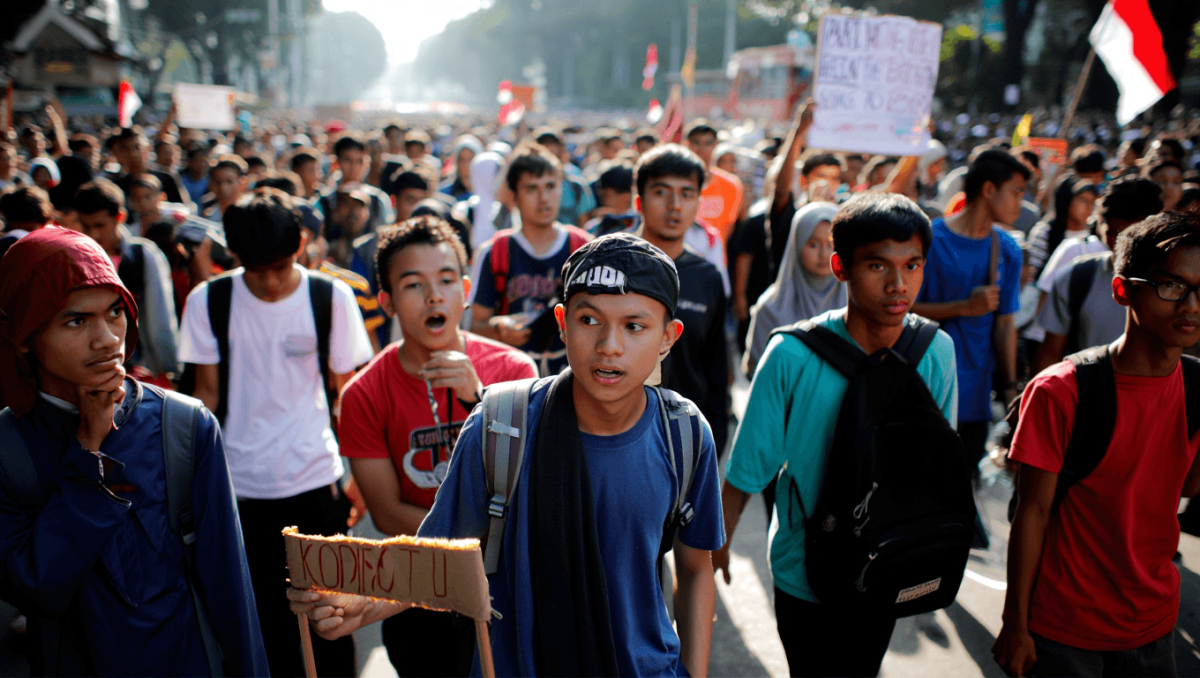
Hundreds of university students filled streets of Jakarta on Friday, demanding relief from rising living costs and urging President Prabowo Subianto to reconsider costly state programs as economic pressure mounts. Their protests come as fuel prices climb and the rupiah weakens, developments with immediate consequences for household budgets and government finances.
About 1,500 demonstrators attempted to march toward the Hotel Indonesia traffic circle after Friday prayers, but police and soldiers blocked key routes and prevented access to the presidential palace. Officials said more than 6,000 security personnel were deployed to contain the rallies.
Students, many wearing yellow university jackets, blamed higher fuel expenses — linked to recent global tensions — for increases in the price of staples and the rupiah’s slide. The currency fell to around 18,000 rupiah to the U.S. dollar earlier this month, a level protesters described as a sign of growing financial strain for ordinary Indonesians.
Boxing champions ditch long runs for high-intensity training: new era in fight prep
Czech nationals among victims of Pinedale-area crash: two confirmed dead
The demonstrators presented a set of clear policy demands, focused on cutting government waste and easing cost-of-living pressures:
- Reduction in perceived wasteful state spending, including reviews of large-scale initiatives.
- Lower fuel prices or targeted support to offset recent increases.
- Cheaper staple foods through subsidies or price controls.
- Suspension of some major programs the students say strain the budget, such as the nationwide free meals initiative.
- An end to measures they argue threaten democratic norms and civic freedoms.
The government’s free meal program, budgeted at about 268 trillion rupiah (roughly $15 billion) for the year, is intended to tackle poverty and malnutrition but has drawn criticism from the protesters, who say its cost is unsustainable amid other fiscal pressures.
“The government is in denial about the current situation,” said Yatalathof Ma’shum Imawan, head of the student group that organized Friday’s demonstration. “We urge Prabowo to acknowledge the problems and make changes.”
Friday’s actions rank among the biggest student-led mobilizations since mass unrest last August, when clashes between demonstrators and security forces resulted in at least 13 deaths. Demonstrations were also reported in Bandung, West Java, and Pontianak on Borneo island, indicating the grievances extend beyond the capital.
Why this matters now: rising energy costs and a weakening currency can quickly erode living standards, pushing food prices higher and increasing political risks for the administration. The protests place immediate pressure on policymakers to balance social spending with fiscal sustainability while avoiding measures that could further inflame public discontent.
Analysts and investors will be watching several signals in the coming days: whether Jakarta responds with targeted subsidies or program cuts, any concrete concessions from the president, and whether the rupiah stabilizes. The government’s next moves could shape both short-term economic relief for households and the political climate ahead.