Show summary Hide summary
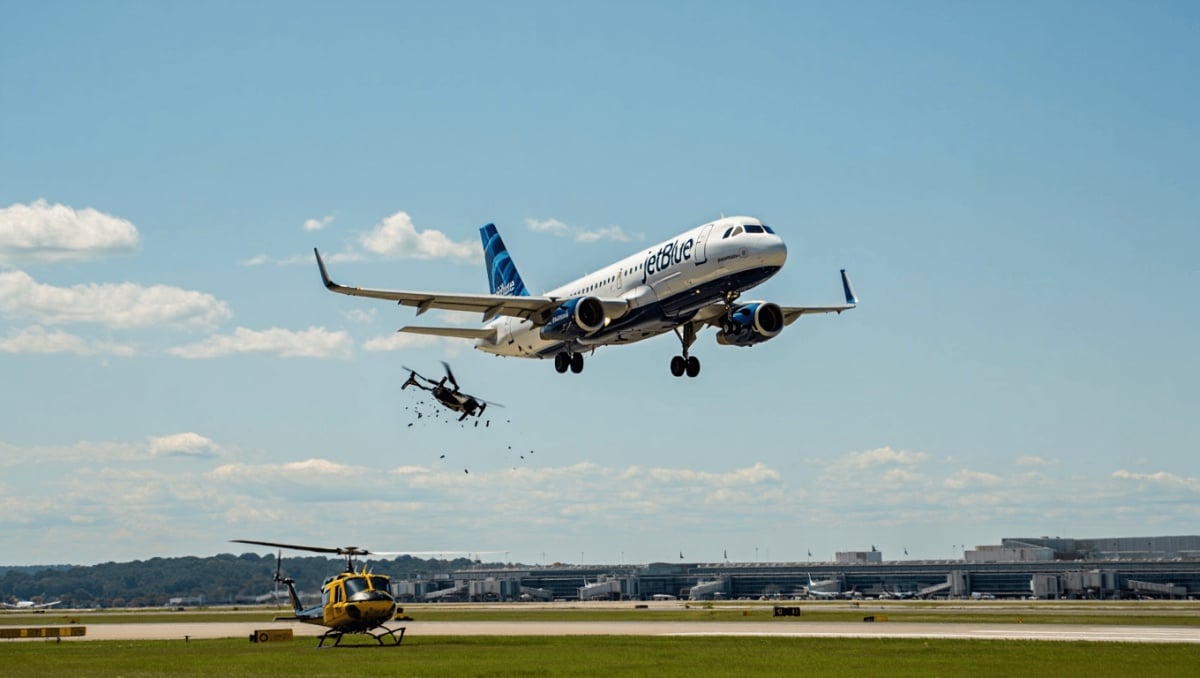
A JetBlue passenger jet reported striking a drone while descending toward John F. Kennedy International Airport on Monday, and hours later a helicopter pilot near the same field warned air traffic control about a close brush with a remote-control aircraft. The pair of incidents have renewed scrutiny of how unmanned aircraft operate around busy airports and what that means for safety and enforcement today.
What happened
The first event involved an Airbus A321 arriving from Las Vegas. The crew told controllers they had been hit “right above the cockpit” as the airplane passed about 3,000 feet over the coastline, according to transcripts made public by air-traffic monitoring services. The jet landed safely at JFK and passengers deplaned normally; JetBlue said postflight inspections found no visible damage.
UFC Edmonton: who to book next, five matchups fans want led by Mike Malott vs Sean Brady
Laramie County arrests: who was booked Sept. 25-Oct. 2
Later the same day the Federal Aviation Administration notified local authorities after a helicopter pilot reported a near miss with a remote-controlled airplane in the same vicinity. The FAA has opened inquiries into both reports.
Why this matters now
These encounters arrive amid a steady stream of drone sightings near airports, raising two immediate concerns: whether current rules and enforcement are sufficient, and how vulnerable large aircraft are to impacts from small, unmanned vehicles. For passengers and pilots, even a single strike can carry operational and safety consequences.
The incidents also test coordination between federal regulators, local law enforcement and industry groups as drone use expands for recreation, commerce and emergency response.
- Incident status: FAA is investigating both the reported collision to the JetBlue jet and the helicopter near-miss.
- Operational outcome: The JetBlue flight landed without diversion; the aircraft was removed from service for inspection and found to have no visible damage.
- Regulatory backdrop: Drones are generally limited to 400 feet above ground and face restricted-airspace rules near airports.
- Enforcement options: Pilots who violate restricted airspace can face fines, license penalties and confiscation of equipment.
How drones can reach aircraft
Federal rules limit most unmanned aircraft to about 400 feet above ground level, but many consumer drones are technically capable of climbing much higher. Scott Shtofman, vice president and counsel for regulatory affairs at the Association for Uncrewed Vehicle Systems International, noted that even modest models weighing around five pounds can ascend into altitudes used by airliners.
“The rules restrict that, but it doesn’t prevent someone from flying beyond legal limits,” Shtofman said, emphasizing the gap between capability and compliance.
That mismatch is where risk concentrates: airport flight paths and approach corridors bring manned aircraft into the vertical range where illegally flown drones can appear.
Scale of the problem and past outcomes
FAA records show that sightings near airports occur frequently — often more than a hundred reports each month — and the agency says it works with law enforcement to pursue violations. Historically, direct drone-aircraft collisions have been rare, but even non-collisions can force evasive action, emergency landings or inspections that disrupt schedules and add cost.
Aircraft are built to tolerate some types of impacts — for example, bird strikes are common and designs account for that threat — but a strike to an engine, windshield or critical control surface could cause serious damage. Investigations following reported encounters sometimes determine there was no physical contact after all; other times they reveal close calls that nonetheless required maintenance or operational changes.
What regulators and operators are doing
The FAA has several tools: education campaigns for recreational pilots, geofencing partnerships with manufacturers, fines and legal enforcement, and coordination with local police when incursions occur. Airlines and airports also review procedures, brief crews on reporting protocols and may adjust operations if persistent drone activity interferes with safe flight paths.
Yet enforcement remains challenging. Identifying individual operators in the moment is often difficult, and proving intent or location after an incident requires timely evidence and cross-agency cooperation.
Implications for travelers and policymakers
For passengers, the practical takeaway is that reported incidents can cause delays, inspections or, in rare cases, diversions — not because drones are ubiquitous at cruising altitude but because even isolated incursions pose outsized risk near approach and departure corridors.
For policymakers, these events underline the need for improved detection, faster investigative tools, and clearer deterrents. As drone technology becomes cheaper and more capable, regulators face pressure to close enforcement gaps without stifling legitimate commercial and public-safety uses.
As the FAA continues its investigations into the two Monday incidents, airlines and travelers will be watching for any new guidance or operational changes that affect flights into major hubs like JFK.