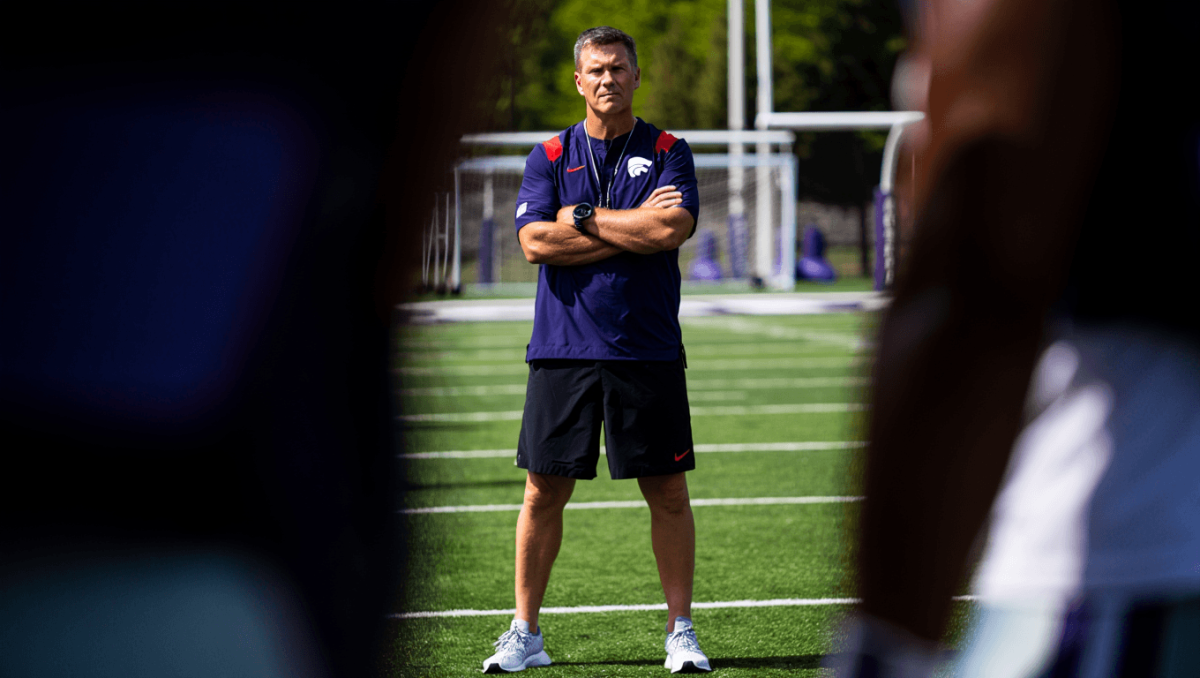
Collin Klein returns to Kansas State as head coach this season, stepping into a program defined by stability and the long shadow of Bill Snyder. His hire matters now because Klein brings College Football Playoff experience and a track record as a steady, hard-nosed leader — qualities that could determine whether the Wildcats remain a Big 12 contender or push toward national relevance.
As a player, Klein was one of the 2012 Heisman finalists, known more for reliability than flash. He produced the kind of balanced production that sustained Kansas State during its best modern stretch: roughly 40 and 39 combined passing-and-rushing touchdowns in 2011 and 2012, guiding the Wildcats to 10-3 and 11-2 records, respectively.
That 2012 squad finished the regular season 11-1 and shared the Big 12 title — a season often measured alongside the program’s 1998 peak. On the national stage, however, Klein’s understated style was eclipsed by flashier narratives: high-octane stars and headline-grabbing storylines grabbed most of the attention in New York that year. In Manhattan, Kansas, his steady play instead became the foundation of a defining era for K-State football.
Boxing champions ditch long runs for high-intensity training: new era in fight prep
Czech nationals among victims of Pinedale-area crash: two confirmed dead
After several seasons on the coaching track, Klein left to serve as offensive coordinator at Texas A&M, where his role helped the Aggies reach their first College Football Playoff. His offense there averaged about 260 passing yards per game, a contrast to the ground-first attack he ran while coordinating at K-State in 2022, which produced nearly 210 rushing yards per game. The split résumé underscores Klein’s adaptability — able to lean on power running or a more aerial approach depending on personnel.
Program context and continuity
Kansas State’s identity is unusually tied to one name: Bill Snyder. Hired in 1989, Snyder rescued a program that had been losing for decades and turned it into a model of steadiness. Before his arrival the Wildcats rarely finished with a winning record; afterward, losing seasons became the exception.
Success continued after Snyder’s retirement. Chris Klieman, who succeeded Snyder in 2019, preserved a strong baseline: the Wildcats posted eight or more wins in five of the seven seasons before Klein took over and captured the 2022 Big 12 championship. That title equaled the number of conference crowns Snyder collected in each of his stints, underscoring K-State’s sustained competitiveness.
Still, the Snyder era sets the standard Klein is expected to meet. He inherits a roster and infrastructure accustomed to winning, which raises the bar: this is a program that does not tolerate long rebuilds.
- Playing pedigree: 2012 Heisman finalist; major contributor to 2011–12 teams that went 10-3 and 11-2.
- Coaching résumé: Two years at Texas A&M as offensive coordinator; helped reach the College Football Playoff.
- Offensive flexibility: Coordinated a 2022 K-State rushing attack (~210 ypg) and later oversaw a passing-focused unit (~260 ypg).
- Program state: K-State has posted multiple eight-win seasons recently and claimed the 2022 Big 12 title under Klieman.
What matters this season is whether Klein can combine Snyder-era steadiness with the offensive versatility he showed at Texas A&M. Can he field teams that punch opponents on the ground while still opening the field through the air when needed? Success will be measured not just in wins but in whether the Wildcats can sustain depth, recruit effectively and compete for conference titles again.
At 36, Klein arrives with the narrative of a hometown star returned to lead his alma mater — but also with concrete expectations. Kansas State fans will be watching for continuity in culture and a clear identity on offense. For observers outside the Little Apple, the plotline to follow is whether Klein’s first season pushes the Wildcats back into playoff contention or simply keeps a dependable program on its established course.
Either way, this is a fresh chapter for a program that has long been defined by consistency. Klein’s opening year will offer an early answer about whether he can be the next long-term face of K-State football — and whether his leadership will elevate the Wildcats to new national heights.