Show summary Hide summary
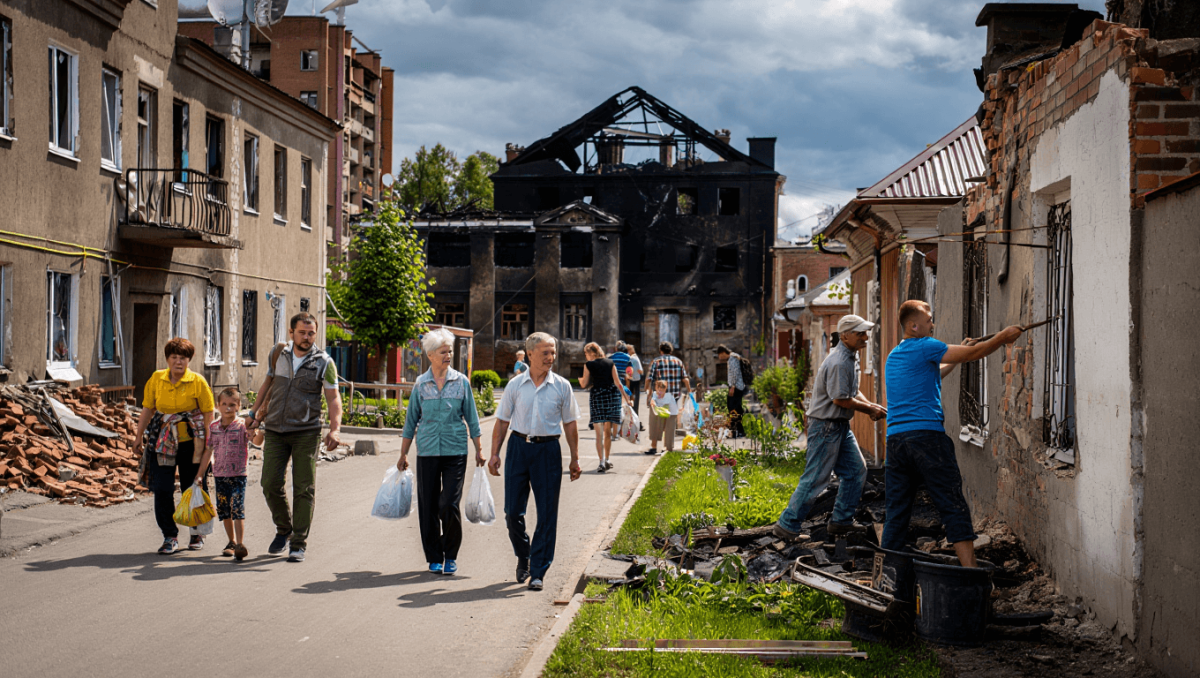
Kyiv’s Lukianivka neighborhood has been forced into an uneasy routine: brace for impact, repair the damage, and keep living. Recent strikes that blackened a century-old market and repeatedly hit a nearby arms plant have turned daily life into a cycle of loss and repair — and reshaped how people work, shop and socialize.
When real estate agent Dmytro Zhekov shows apartments, he leads with practicalities: proximity to the city center, a metro stop and modest rents — then adds an unvarnished caveat about security. “I tell them straight away: this area gets hit regularly. If you can live with that, we can look,” he said.
Residents point to the same landmarks that make Lukianivka familiar: the rust-streaked roof of the former industrial plant, the metro station that doubles as a wartime shelter, and a street that once funneled merchants into Kyiv. That industrial site has been struck repeatedly, its blackened silhouette a constant reminder of the neighborhood’s exposed position.
Boxing champions ditch long runs for high-intensity training: new era in fight prep
Czech nationals among victims of Pinedale-area crash: two confirmed dead
Dehtiarivska Street still follows an ancient pathway into Kyiv, but modern life here is defined by repair kits and the smell of scorched rubble. After each attack, people sweep glass, board windows and reopen businesses beside ruins; after a recent weekend barrage the same weary ritual restarted.
A market frozen in time
The neighborhood market, a fixture since the 19th century, was gutted in a strike on May 24 and now stands as a charred labyrinth. Shelves that once held everyday staples are blackened; loaves of bread remain as mute evidence of the moment missiles struck.
Alyona Lukianets spent more than a decade building a produce stall there. She returned after the attack to find only ash and twisted metal. Within weeks she had improvised a new stand from pallets and tarpaulins, placing baskets of berries and vegetables on the rebuilt counter as if to insist that commerce — and memory — continue.
“We keep coming back,” she said. “This place is where our family stories are. It’s not so easy to walk away.”
Factory in the crosshairs
The site known locally as the Artem plant dates to the 19th century and later became a major weapons manufacturer under Soviet and post-Soviet industry. Since Russia’s full-scale invasion, Moscow has repeatedly targeted the facility, saying it believes weapons production continues there — a claim Ukrainian authorities do not discuss in public because of wartime restrictions.
That calculus leaves neighbors weighing risk against daily needs. Lukianivka remains one of the more affordable central districts of Kyiv: studios can start under $200, and small one- and two-bedroom units are available for roughly $270–$310, according to local listings. For many renters and small-business owners, those prices outweigh the fear that another strike could come.
Julia Sosnovska, originally from Mariupol, moved to Lukianivka in 2022 and chose an apartment that overlooks the industrial site. After a recent night strike she woke to a blinding flash and the sound of glass shattering. She gathered her dog, documents and laptop and spent the night in the building’s basement garage with neighbors.
“Glass can be replaced,” she said. “But what else are you supposed to do when you don’t know which part of the city will be next?”
- Safety: Repeated strikes have normalized emergency routines — shelters, blackout curtains and spare panes of glass kept on hand.
- Economy: Small vendors rebuild quickly but often operate from makeshift stalls, extending the local supply chain despite damage.
- Housing: Lower rents attract new residents, including people displaced from other regions, sustaining demand even under threat.
- Culture: Theaters and schools relocate performances and lessons to basements or online, keeping community life alive.
- Psychology: Residents speak of living with a background anxiety — not whether an attack will happen, but when.
Life has adapted in unexpected ways. A barber who runs a school in the neighborhood leaves displays of broken brick and shrapnel as everyday reminders; patrons clip hair in rooms scarred by past blasts. The Mala Opera has shifted productions to basement stages, choosing mostly comedies to offer audiences a brief respite from the wider conflict.
Director Mykhailo Miskun described the company’s intent plainly: to keep producing work that helps people breathe. Rehearsals have moved online at times and performances now take place in smaller, safer spaces — but the theater has not closed.
For many in Lukianivka, staying is a deliberate choice rather than resignation. Residents say moving elsewhere offers no guarantee of safety: strikes have reached across the city, and uprooting family, work and social ties carries its own cost.
“We rebuild so we can keep living our lives,” Zhekov said. “That’s how the neighborhood endures.”
Correction: Julia Sosnovska is originally from Mariupol.