Show summary Hide summary
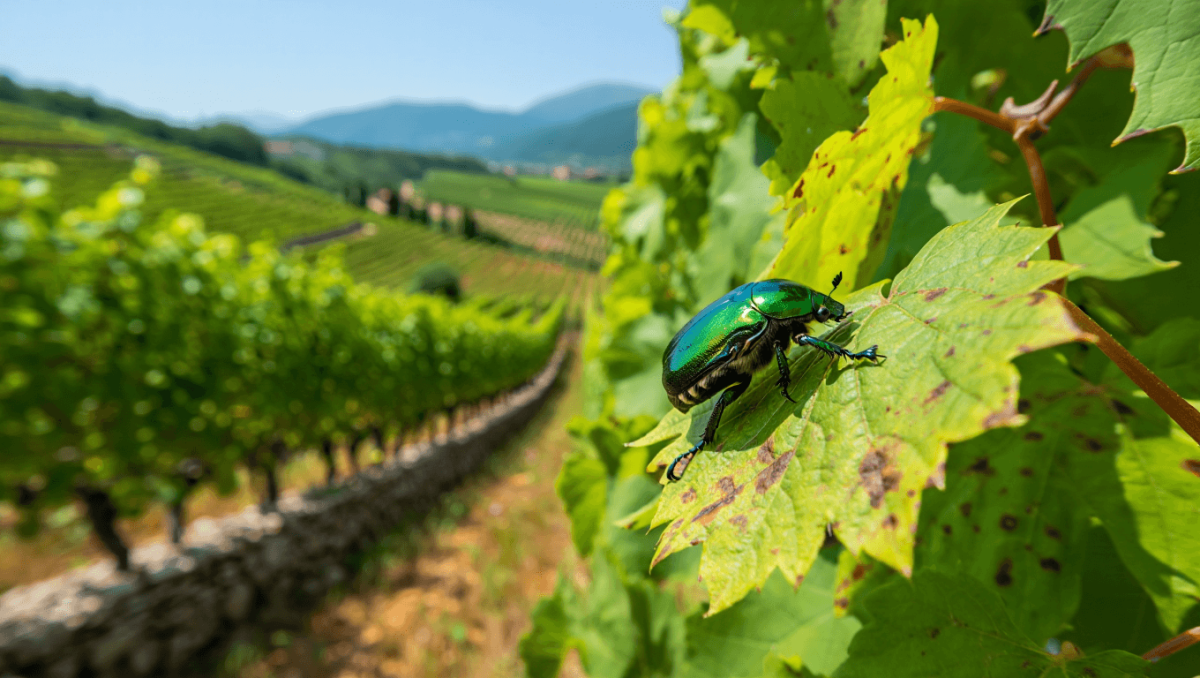
Italian vineyards and orchards are facing a new threat as iridescent green beetles native to Japan continue to advance through northern regions, stripping leaves and undermining plant health. The spread — now visible on terraced Nebbiolo vines above Donnas and recently recorded near Verona’s airport — raises fresh concerns for yields across the country’s agricultural heartland.
First detected in Europe just over a decade ago, the insect known as Popillia japonica has proven a tenacious invader. In summer adults swarm and feed in groups, leaving telltale lace-like damage; their larvae, or grubs, spend months underground chewing grass roots before emerging as the next generation.
Local growers describe a steady uphill march. Luciano Zoppo Ronzero, who farms steep, drystone terraces, says the beetles have progressed terrace by terrace and are now attacking vines higher on the slope — a pattern that threatens both plant vigor and fruit development. Where leaves are heavily eaten, bunches are exposed to sunburn and vines lose the capacity to photosynthesize fully, reducing grape ripeness and potentially the quality of the harvest.
Boxing champions ditch long runs for high-intensity training: new era in fight prep
Czech nationals among victims of Pinedale-area crash: two confirmed dead
Entomologists and agricultural authorities view the beetle as a serious biosecurity issue. The insect is on the European Union’s list of priority pests, meaning coordinated containment and eradication efforts are required once outbreaks are identified.
Where the pest stands now
Popillia japonica is already established in parts of northern Italy and neighboring countries, and surveillance teams are racing to limit further spread. Daniela Lupi, an entomologist at the University of Milan, says populations are entrenched in Italy, Switzerland and Germany, where management is now focused on control rather than eradication. In contrast, lower population levels in France and Spain still leave a window for possible elimination.
- Arrival in Europe: First found near Milan’s Malpensa airport in 2014.
- Regions affected: Northeastern Italy — including Lombardy, Piedmont and Valle d’Aosta — with recent finds near Donnas and around Verona.
- Diet breadth: Feeds on more than 300 species of plants, from fruit trees and ornamentals to grapevines and grasses.
- Lifecycle: Adults feed above ground in summer; larvae (grubs) feed on roots through autumn and spring.
- Spread mechanisms: Natural flight and mass movements while feeding, plus accidental transport on vehicles, trains and airplanes.
The agricultural lobby Coldiretti warns the insect could inflict heavy damage as it moves into the Po River Valley, a major production zone. Quantifying losses is difficult: the beetles’ typical feeding weakens plants and lowers yields without immediately killing mature specimens, so impacts can be subtle yet economically significant.
Larval control is widely seen as the most promising route to suppression. Authorities and scientists are trialing biological options — including the release of microscopic parasites that attack grubs near transport hubs where new incursions are detected — while growers deploy pheromone traps and targeted pesticides. For producers on steep terraces, chemical treatments are challenging and provide only temporary relief, and manual work on slopes raises labor demands and costs.
What it means for producers and consumers
The immediate stakes are pragmatic rather than health-related: the beetles are not a danger to people, but their pressure can shrink harvest volumes and raise production costs across multiple sectors, from wine and fruit to turf management at sports facilities. For small, historic sites such as terraced vineyards, the threat is both economic and cultural — prolonged infestations could undermine landscapes that have been farmed for centuries.
Experts caution that without sustained, coordinated action the population will likely expand, increasing pressure on fruit crops, grasses and ornamental plantings. Success depends on early detection at likely entry points, aggressive larval controls, and cross-border collaboration to prevent further establishment.
For now, Italian vintners and agronomists are balancing short-term defensive measures with experimental biological controls — a race against a pest that travels quickly and eats broadly. How effectively those efforts hold will shape yields and landscape health across a region that supplies much of the country’s food and wine.