Show summary Hide summary
The Biden administration has moved forward with a plan to offer roughly 33 million acres of ocean around American Samoa for seafloor mineral leases, setting up a clash between strategic resource goals and urgent environmental and local concerns. The proposal touches on global supply chains for batteries and defense systems, while reopening debates about sovereignty, marine protection and whether poorly understood deep waters should be opened to mining now.
The U.S. proposal targets a broad swath of seabed inside the country’s exclusive economic zone, where Washington exercises sovereign rights over natural resources. Officials say the areas could contain copper, cobalt, nickel and other metals that industries and the military increasingly need. Opponents — from local community groups to international scientists — warn that mining could harm fragile ecosystems and cultural lifeways before impacts are fully understood.
What the plan would do
Boxing champions ditch long runs for high-intensity training: new era in fight prep
Czech nationals among victims of Pinedale-area crash: two confirmed dead
Federal regulators are proposing large commercial lease sales that, in initial stages, would allow surveys and sampling to map the seafloor and its living communities. The Department of the Interior’s bureau that oversees ocean minerals has described multiple lease-size options to retain flexibility as studies proceed, while emphasizing that any actual extraction would require a separate, detailed approval and environmental review.
Environmental groups and American Samoan advocates say the timeline is too compressed and that early approvals effectively make the territory a testing ground for an industry with scant track record and large scientific unknowns.
| Item | Details |
|---|---|
| Area proposed | About 33 million acres (≈51,560 sq. miles) |
| Water depth | Roughly 4,600 to 20,000 feet (1,400–6,000 meters) |
| Distance to Rose Atoll | Approximately 57 miles (92 km) |
| Lease scenarios | Up to two very large leases (~17 million acres each) or multiple smaller leases (~7 million acres each) |
| Activities initially allowed | Geophysical surveys, biological sampling, oceanographic monitoring |
| Regulatory context | Area lies in U.S. EEZ; International Seabed Authority has no jurisdiction there |
Local and global pushback
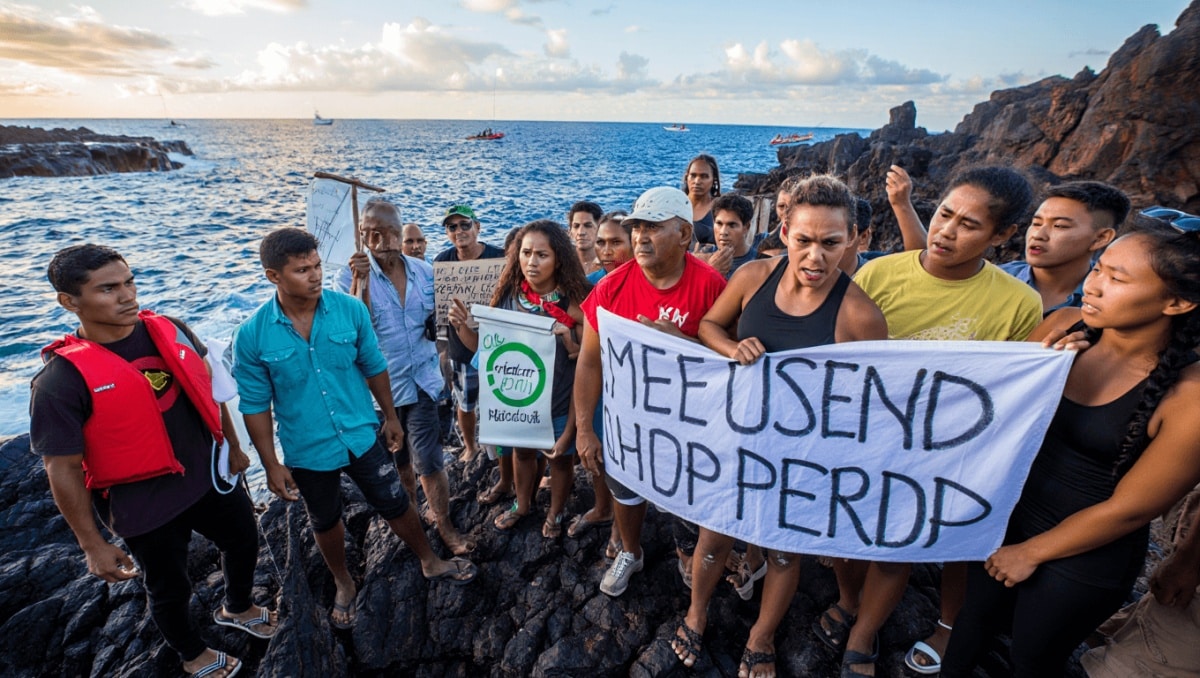
Grassroots groups in American Samoa, which has already prohibited deep-sea mining inside its territorial waters, have criticized the federal move as dismissive of local voices and of customary relationships with the ocean. Legal advocates accusing the government of moving ahead despite significant unresolved questions say the decision could expose delicate coral, fish and seabed communities to irreversible harm.
More than 40 countries and numerous research organizations have called for a pause on commercial deep-sea mining until the ecological risks are better known. The international body that oversees seabed mineral activity in areas beyond national jurisdiction has cleared exploration contracts for several firms but has not permitted any commercial recovery.
Why Washington is pushing ahead
Officials argue that access to critical minerals is now a national security and economic priority. U.S. regulators point to supply-chain vulnerabilities and the concentration of processing capacity overseas as reasons to develop domestic sources of metals used in batteries, electronics and defense technologies.
In recent months, U.S. agencies have altered permitting procedures to allow companies to seek exploration and commercial operation approvals in parallel, shortening what had been a staged process. An executive order earlier this year instructed agencies to accelerate work on seafloor mineral policy, signaling a clear administration priority to move the sector forward.
That approach raises questions about whether scientific monitoring and environmental safeguards can keep pace with industry-driven timelines.
Scientific unknowns and possible impacts
Deep-sea environments near the proposed sites are poorly mapped and studied. Government assessments note significant data gaps about biodiversity and ecosystem functions at depth. Scientists warn that mining can produce long-lived sediment plumes, introduce noise and light into dark habitats, and remove or smother organisms adapted to stable, low-energy conditions.
Even limited survey work can disturb bottom-dwelling species and create cascades of ecological change that are difficult to predict or reverse. For communities that rely on healthy reefs and fisheries, those risks translate into social and cultural as well as environmental threats.
- Potential direct harms: Sediment plumes, habitat removal, noise and chemical disturbance.
- Indirect risks: Food-web changes, reduced fisheries productivity, harm to protected areas like Rose Atoll.
- Socioeconomic stakes: Threats to subsistence fishing, tourism, and cultural practices tied to the ocean.
International context
Most large-scale exploration to date has been concentrated in the Clarion-Clipperton Zone between Hawaii and Mexico, where international contractors operate at extreme depths. Unlike those international waters, the waters around American Samoa sit inside the U.S. EEZ, giving Washington the legal authority to set rules. That distinction means the move will have diplomatic resonance but not direct procedural implications for the U.N.-backed seabed regulator.
Observers say the plan will be watched closely by allies and competitors alike, because any new U.S. supply of submarine-sourced metals could shift commercial and strategic calculations for the global marketplace.
For now, the immediate path forward hinges on comment periods, environmental reviews and potential legal challenges. The debate is likely to continue in courtrooms, scientific journals and community meetings as policymakers weigh the urgency of securing minerals against the risks of opening poorly known ocean regions to industrial-scale extraction.