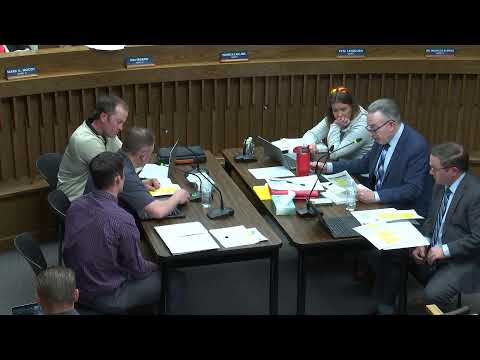
Cheyenne city leaders voted Monday to eliminate the municipality’s dedicated stormwater funding, a move officials say buys time in a dispute with the Wyoming Legislature but critics warn could weaken the city’s flood preparedness. The repeal removes a fee intended to finance stormwater projects that city staff had linked to reducing flood risk and repairing drainage infrastructure.
The decision to rescind Ordinance 4603 came after Mayor Patrick Collins described the action as a strategic concession to avoid having the Legislature impose a blanket ban on the fee. City Hall framed the repeal as a temporary step to preserve some degree of local authority while negotiations continue with state lawmakers.
Opponents argued the move compromises public safety. Former councilor Richard Johnson recalled the widespread damage from the 1985 flood and said removing a dedicated revenue stream abandons long-term mitigation efforts. Several current council members also expressed serious reservations before ultimately voting.
Boxing champions ditch long runs for high-intensity training: new era in fight prep
Czech nationals among victims of Pinedale-area crash: two confirmed dead
The council vote split, with councilors Ken Esquibel, Pete Laybourn and Lawrence Wolfe opposing the repeal. Wolfe said the council should instead increase investment in drainage and flood defenses rather than dismantle the funding mechanism.
Supporters pointed to the fee’s effect on major local employers. Councilor Mark Moody highlighted monthly charges levied against large properties, describing the sums as burdensome for industrial operators and data centers. He cited figures officials presented showing significant monthly bills for rail and tech facilities.
Beyond the stormwater measure, the council moved several zoning changes forward, approving second readings that will now go to a final vote. The most notable amendments affect the Harmony Valley area, where land north of West College Drive and south of West Allison Road is being redesignated to allow denser housing.
Planned development in that corridor includes five apartment buildings with 24 units apiece and roughly 196 “cottage” lots. Mayor Collins said those smaller-lot homes will sit on parcels just under 4,000 square feet and are expected to list in the low $300,000 range—a price the mayor described as relatively attainable compared with local market norms.
Other zoning adjustments approved on second reading include changing undeveloped tracts north of Allison Road from agricultural to high-density residential, and a medium-density reclassification near East 29th Street and Central Avenue to enable the sale of an existing townhome complex as individual lots. The council also advanced an ordinance to vacate Frank Court and a portion of a previously vacated alley.
Several first-reading ordinances were referred to committees for further review. Items sent to committee include a revision of local wastewater discharge limits to meet environmental permit requirements, an expansion of the Downtown Development District’s boundaries, and a request to allocate General Fund reserves for the Reed Avenue Corridor Project.
What this means for residents and businesses:
- Stormwater financing: The city has lost its dedicated fee source for projects that would reduce flood risk, at least for now.
- Local control: City leaders say the repeal aims to avoid a state-imposed prohibition that could be more restrictive.
- Business costs: Large property owners previously faced substantial monthly charges; supporters argued those levies hurt economic partners.
- Housing development: Rezoning approvals move new multi-family and smaller-lot single-family housing closer to construction, potentially easing supply pressures.
- Environmental compliance: Changes to wastewater limits are underway to ensure permits and state rules are met.
The council’s votes reflect a balancing act between fiscal and regulatory pressures from the state and long-term infrastructure needs at the local level. City officials say talks with state legislators will continue; opponents warn that without a stable funding source, the city could be less prepared for major storm events.
As the ordinances progress through final readings and committee hearings, residents and businesses can expect further debate over both funding strategies for drainage projects and the pace of new housing development.