
Show summary Hide summary
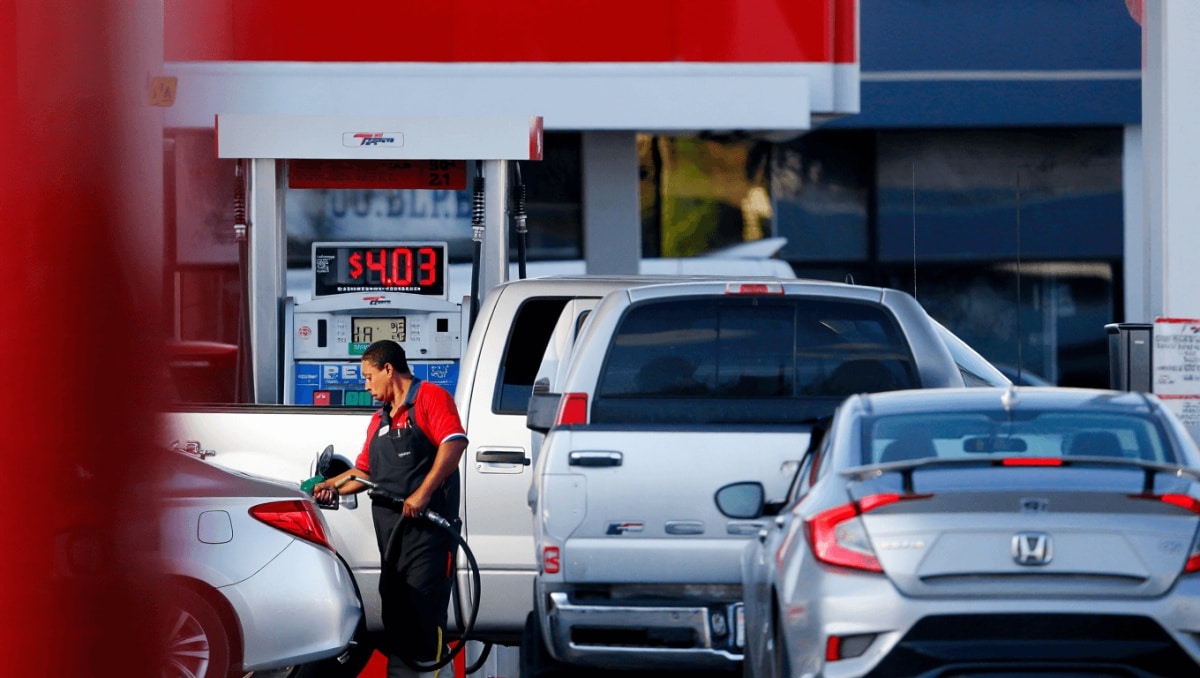
Gasoline in Laramie County jumped 18 cents this week, adding to a rapid run-up that has pushed pump prices up 83 cents in the last 21 days. The spike mirrors a sharp climb in nationwide fuel costs and raises the real prospect that the U.S. **national average** could top $4 per gallon within days—an outcome that would affect household budgets and travel costs statewide.
Locally, AAA reports Laramie County’s average at $3.58 per gallon this week. GasBuddy’s compilation of more than 12 million price reports puts the U.S. average at $3.92 per gallon after a 24.3-cent weekly increase; that figure is nearly a dollar higher than a month ago and about 84 cents above this time last year. Diesel is rising faster: the national average for **diesel** climbed 27 cents to $5.227 per gallon.
Drivers in Cheyenne can still find cheaper pumps—with the lowest reported prices today at:
Boxing champions ditch long runs for high-intensity training: new era in fight prep
Czech nationals among victims of Pinedale-area crash: two confirmed dead
- Sam’s Club (1948 Dell Range Blvd.): $3.39
- Flying J (2250 Etchepare Drive): $3.49
- Love’s Travel Stop (3305 W. College Drive): $3.49
- Gasamat (620 E. Lincolnway): $3.49
How Wyoming counties compare
Across the state, county averages shifted unevenly. Goshen County moved from the second-lowest spot last week to the cheapest in Wyoming at $3.37 per gallon despite a 17-cent weekly increase. Crook County averaged $3.43 and Carbon County $3.49, according to AAA’s latest figures.
What’s driving prices now
Two forces are colliding: supply-side jitters tied to tensions in the Middle East and seasonal factors that typically lift demand heading into warmer months. Markets have been especially sensitive to developments around the Strait of Hormuz—an essential corridor for roughly one-fifth of global oil shipments—where any hint of disruption quickly pushes prices higher.
Markets were briefly relieved after reports that U.S. leaders agreed to pause potential strikes on Iranian energy facilities while diplomatic talks proceeded; that news sent crude prices down early in the week. Still, analysts warn the calm could be short-lived. Headlines can swing prices sharply if negotiations falter, keeping volatility elevated even as underlying supply and demand fundamentals continue to matter.
Oil benchmarks and inventory snapshot
In recent trading, West Texas Intermediate fell to about $92.60 per barrel — down several dollars from the prior week — while Brent slipped to roughly $105.61 per barrel. Despite the pullback, both benchmarks remain elevated compared with last year.
- EIA weekly snapshot (week ending March 13, 2026):
- U.S. oil inventories: +6.2 million barrels (≈1% below seasonal average)
- Strategic Petroleum Reserve: unchanged at 415.4 million barrels
- Gasoline inventories: −5.4 million barrels (≈3% above five-year seasonal average)
- Distillate inventories: −2.5 million barrels (≈3% below five-year seasonal average)
- Refinery utilization: 91.4% (up 0.4 percentage points)
- Implied gasoline demand: 8.728 million bpd (down 513,000 bpd)
Price patterns motorists are seeing
The most frequently reported retail gasoline price nationally is now $3.69 per gallon, up about 20 cents week-over-week. The median U.S. price sits near $3.79, which is roughly 13 cents below the overall average. At the extremes, the top 10% of stations charge about $5.57 per gallon, while the lowest 10% average $3.25.
| Category | Lowest states | Highest states |
|---|---|---|
| Gasoline | Oklahoma: $3.21; Kansas: $3.25; Iowa: $3.33 | California: $5.75; Washington: $5.23; Hawaii: $5.19 |
| Diesel | Kansas: $4.51; Oklahoma: $4.52; Missouri: $4.61 | California: $6.88; Washington: $6.36; Hawaii: $6.17 |
Weekly movers show steep local swings: Illinois led gasoline increases (+39.7¢), followed by Idaho and Oregon (both ~+32¢). On the diesel side, California posted the largest jump (+50.5¢), with Utah, Connecticut and Pennsylvania also seeing substantial rises.
For consumers, the immediate implications are straightforward: higher travel and shipping costs and greater pressure on household budgets if prices continue to climb. For markets, the key signals to watch are crude-price reactions to diplomatic developments and the next weekly inventory release—both of which will influence whether the upward trend pauses or accelerates.