Show summary Hide summary
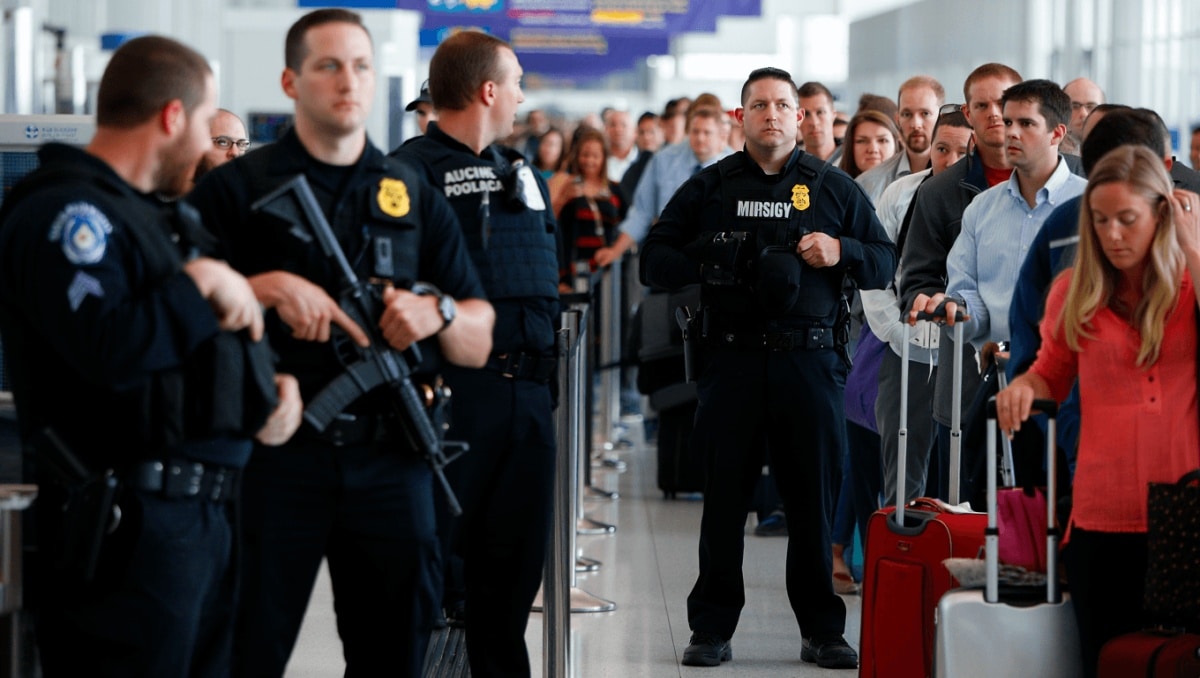
Armed immigration officers in tactical gear began appearing at several of the country’s busiest airports Monday, a visible consequence of the partial federal shutdown that has strained security staffing and unsettled travelers. Their presence, positioned near TSA lines and checkpoints, raises immediate questions about operational roles and passenger anxiety as negotiations in Washington remain stalled.
Journalists observed ICE personnel patrolling terminal concourses and standing near long screening queues at hubs including Hartsfield–Jackson Atlanta, New York’s JFK, Newark Liberty, Houston’s George Bush Intercontinental and New Orleans’ Louis Armstrong. Phoenix Sky Harbor confirmed a similar deployment, and Chicago officials said they were tracking a federal presence at O’Hare.
Federal law enforcement has long worked at international gates—Customs and Border Protection screens arrivals and Homeland Security Investigations handles criminal probes—but immigration agents are not typically visible at the front-line TSA checkpoints that process domestic travelers. The sudden, highly visible deployment has therefore drawn attention and, for some, unease.
Boxing champions ditch long runs for high-intensity training: new era in fight prep
Czech nationals among victims of Pinedale-area crash: two confirmed dead
What observers saw and what passengers reported
At Atlanta’s airport, lines for departing flights extended through the atrium and out the entrance, with airline and federal personnel trying to manage the backlog. Officers wearing ICE insignia were seen walking terminal aisles but not routinely checking IDs or interacting with passengers.
- Hartsfield–Jackson (Atlanta) — long security lines; ICE officers patrolling concourses.
- JFK (New York) — officers stationed near screening areas.
- Newark Liberty (New Jersey) — ICE presence near passenger queues.
- George Bush Intercontinental (Houston) — agents observed in public areas.
- Louis Armstrong (New Orleans) — federal officers on-site; some passengers arrived hours early.
Travelers gave mixed reactions. One Atlanta passenger said she didn’t object to seeing immigration agents but questioned their necessity, while another worried that their presence could cause anxiety for others. A New Orleans traveler who had missed a prior flight said lines appeared to move faster but questioned whether the expense of sending ICE personnel to airports was justified.
Washington standoff and staffing fallout
The deployments come against the backdrop of a budget impasse that left funding for the Department of Homeland Security lapsed on Feb. 14. While routine pay for many TSA agents has been halted, immigration enforcement staff have continued to work and receive paychecks — a disparity that has become a flashpoint in talks.
Officials say the additional personnel were sent to supplement thinning TSA ranks, but details about specific responsibilities remained limited. The White House rejected the latest congressional offer to fund parts of the department without including immigration operations, and the president has publicly suggested expanding the response to include the National Guard if necessary.
Union leaders representing aviation security workers criticized the move, arguing federal immigration officers lack TSA’s checkpoint training. Everett Kelley, president of the American Federation of Government Employees, said his members “deserve to be paid, not replaced by untrained, armed agents,” underscoring union concerns over safety and labor rights.
Operational effects on airports
The shutdown’s impact on front-line screening has been tangible. DHS data shows a surge in missed shifts among TSA staff, with an 11.8% call-out rate nationwide on Sunday — the highest since the funding lapse — equaling more than 3,450 absences. The department also reported over 400 TSA resignations during the shutdown.
Some airports have temporarily closed checkpoints or altered operations because of staffing shortages, prompting officials to advise travelers to plan for longer processing times. Separately, air traffic disruptions on the East Coast — including a runway accident at LaGuardia that authorities say resulted in fatalities and multiple injuries — further complicated travel for many passengers.
How broadly ICE will be used at checkpoints remains unclear. Administration officials have discussed several roles, from monitoring exit lanes to checking IDs, but so far the agents have primarily been visible in terminal areas rather than conducting routine checkpoint screening.
Why this matters now
The issue ties immediate traveler experience to broader political and operational stakes: continued funding uncertainty threatens the day-to-day functioning of airport security, heightens labor tensions, and places federal immigration enforcement in a new, more public role. For travelers, the practical consequences are longer lines, unpredictable staffing, and the added stress of seeing armed officers in high-traffic public spaces.
As negotiations in Washington continue with little sign of rapid resolution, airports may remain the stage where national policy disputes are most visible — and where the effects of the shutdown will be felt by millions of people trying to move through the system.