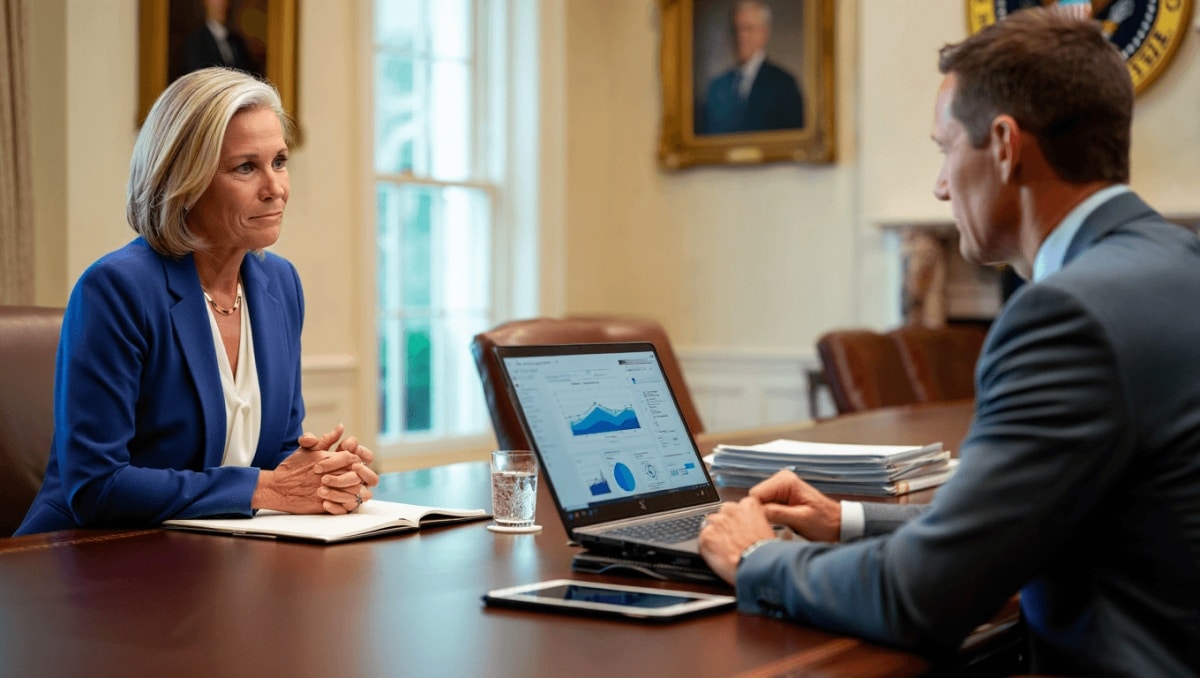
White House chief of staff Susie Wiles met on Friday with Anthropic CEO Dario Amodei to discuss the company’s newly unveiled model, a development that federal officials say may have far-reaching implications for national security and the economy. The session underscores Washington’s increasing appetite for direct talks with advanced AI labs as leaders weigh the risks and benefits of rapidly advancing systems.
The meeting, described by a White House official who spoke on the condition of anonymity ahead of the conversation, focused on the technical and security questions any cutting-edge AI system raises before it can be considered for government use. Administration aides emphasized that novel tools need time and technical review to determine whether they are safe and suitable for federal deployment.
Afterward, the White House called the exchange “productive,” saying it explored areas for collaboration and stressed a desire to strike a balance between technological progress and public safety. Anthropic issued a statement saying the discussion involved senior officials and touched on shared priorities such as cybersecurity, preserving U.S. leadership in artificial intelligence and ensuring AI safety. The company added it looked forward to continuing talks.
Boxing champions ditch long runs for high-intensity training: new era in fight prep
Czech nationals among victims of Pinedale-area crash: two confirmed dead
The backdrop to the meeting is a period of tension between the company and parts of the federal government. The dispute began over Pentagon procurement decisions and grew louder when the White House issued a directive restricting federal agencies from using the company’s services — an order a federal judge later moved to block.
Defense officials have raised concerns about supply chain exposure, and Anthropic has gone to court to challenge some of the government’s moves. The company has sought clear assurances that its models would not be used in ways that would surveil Americans or otherwise cross legal limits; Pentagon leaders have responded that the department must retain the ability to use technologies in lawful operations.
Anthropic’s new model, called Mythos, was unveiled in early April and is being distributed only to a limited set of customers. The company says the system can outperform human cybersecurity experts at spotting and exploiting software vulnerabilities — a capability that has drawn both alarm and interest.
Industry reactions have been mixed. Some observers suspect marketing hyperbole, while others — including prior tech advisers who have publicly criticized Anthropic in the past — warn the claims warrant serious attention because more powerful code-generation models naturally get better at finding bugs and chaining exploits together.
Outside the United States, the model has already attracted scrutiny. The U.K.’s AI Security Institute described Mythos as a meaningful jump ahead of prior systems and warned that similarly capable models are likely to appear. European officials are also engaged in dialogue with Anthropic about models not yet released in the region, according to the European Commission.
- National security: Faster discovery of software flaws could be used defensively to harden systems or offensively to create exploits.
- Supply chain risk: Government officials are weighing whether reliance on a single vendor introduces vulnerabilities to critical infrastructure.
- Regulatory and legal stakes: Court challenges and agency directives signal a broader contest over how the government governs access to advanced AI.
- International ripple effects: Regulators abroad are monitoring the technology as similar models may soon circulate globally.
- Industry response: Anthropic has invited major companies into a coordinated effort to use the model for finding and fixing vulnerabilities.
Anthropic is also launching an initiative named Project Glasswing, which it says will pool resources from large technology and financial firms to scan and secure critical software against the types of threats it believes could follow from these capabilities. Company executives say the rollout of Mythos to a handful of major organizations is intended to identify vulnerabilities before the technology becomes more widely available.
At a recent conference, Anthropic’s policy lead noted that comparable systems are likely to appear from other companies within months, and that open models overseas may close the gap within a year or more. That trajectory — more powerful tools appearing faster and more broadly — is the reason officials in Washington and abroad are accelerating engagement with developers now.
The White House-Amodei meeting was first reported by Axios and reflects an increased willingness among U.S. officials to engage directly with AI firms even amid disputes. As advanced models move from research labs into the hands of corporations and governments, those conversations are likely to become more frequent and more technical.
For now, the central question remains practical: can policymakers and technologists develop regimes that let society harness these tools’ defensive and economic benefits while limiting their potential to create new cyber harms?