Show summary Hide summary
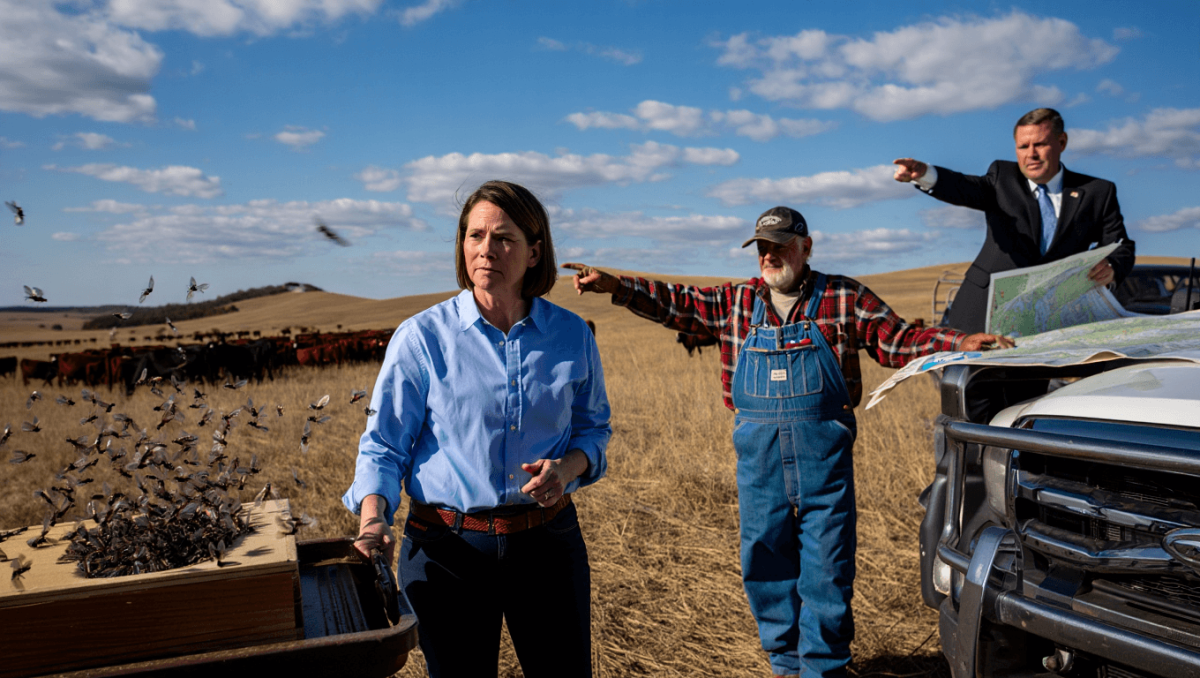
U.S. Agriculture Secretary Brooke Rollins visited a Texas ranch on Thursday and observed the release of sterile flies as officials race to contain the return of the New World screwworm, a parasitic fly that poses a major risk to cattle. The outbreak has prompted a rapid, costly federal response because, if unchecked, the pest could cause serious herd losses and disrupt the beef market.
How the threat spreads and why sterile flies matter
Screwworm larvae hatch from eggs laid in open wounds and feed on living tissue, a behavior that can quickly ruin an animal’s health. For decades, the most effective control has been releasing sterilized male flies: when females mate once with a sterile male, their eggs fail to develop and the population collapses.
Boxing champions ditch long runs for high-intensity training: new era in fight prep
Czech nationals among victims of Pinedale-area crash: two confirmed dead
Scientists warn that warmer, more humid conditions are extending the insect’s potential range. In tropical settings a full life cycle can take only a few weeks, allowing populations to expand rapidly when the climate is favorable.
What officials are doing now
The U.S. Department of Agriculture is moving forward with what it calls an intensive response plan, including building facilities to rear sterilized flies at scale. Secretary Rollins has shifted more than 100 USDA staff into the effort and observed early field releases at the Texas site where a calf was found infested in a navel wound.
- Estimated federal spending: more than $1 billion for containment and response
- Production capacity planned: facilities aimed to produce up to 300 million sterile flies per week
- Recent U.S. detections: several cases confirmed in Texas and New Mexico this season
- Quarantine measure: roughly a 12-mile (20-kilometer) zone established around each detection
- Regional impact: Mexico has reported over 28,000 cases since the pest reappeared two years ago; cross-border trade restrictions followed
Trade effects and regional response
Trade has already been affected: the United States temporarily closed some southern ports to Mexican livestock last summer, Mexico has limited live-animal imports from the U.S., and Canada briefly curtailed livestock imports from Texas. Those moves underscore the economic stakes for ranchers and exporters across the continent.
Scientific uncertainty and next steps
Researchers do not yet have a definitive explanation for how the screwworm escaped the containment zone it had been held in for decades in the narrow isthmus of Panama. “We don’t have a clear answer,” said Jonathan Cammack, a livestock entomologist, noting that speculation is unhelpful while teams concentrate on mitigation.
Experts emphasize that the immediate priority is scaling up the sterile fly releases and coordinating internationally to push the pest back toward southern containment areas. Notre Dame researcher Lee Haines points to the species’ dependence on warmth and humidity as a key reason the insect is moving into places that were previously marginal habitat.
Politics and staffing debates
The outbreak has become politically charged. Secretary Rollins has criticized the previous administration, saying the parasite’s northward movement began while that administration was in office. She also suggested animals traveling with migrants or moving through illicit channels may have contributed to spread, assertions for which officials have not provided public evidence.
Democrats in Congress counter that staffing reductions at the USDA’s Animal and Plant Health Inspection Service have weakened oversight. A bipartisan group of Democrats recently told Rollins that nearly one in five counties that began 2025 with at least one APHIS employee ended the year without any, raising concerns about gaps in inspection and surveillance.
Representative Ted Lieu of California argued this week that the current administration’s staffing choices contributed to the crisis and called for accountability.
What livestock owners should watch for
Veterinarians and agricultural officials say the infestation can be stopped if producers remain vigilant. Ranchers are urged to regularly check animals for wounds, treat and protect injuries promptly, and report suspected cases right away so quarantine and treatment can be enacted.
Bottom line: The screwworm’s return has triggered a large-scale, costly federal campaign focused on a proven biological control method, but success will depend on fast detection, broad cooperation across borders, and sustained production of sterilized flies to interrupt breeding cycles and protect herds.