Show summary Hide summary
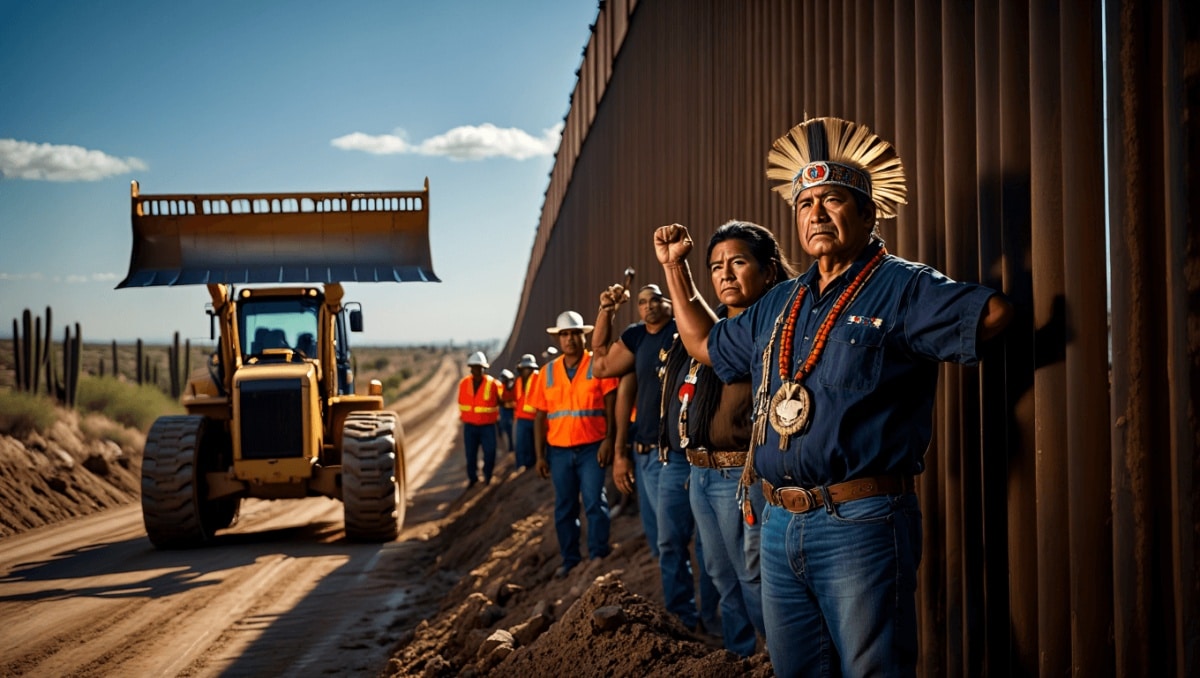
Federal contractors are using explosives and heavy equipment on Indigenous cultural landmarks along the U.S.–Mexico line, a rapid escalation tied to renewed wall-building efforts that tribal leaders say is destroying sacred places and irreplaceable archaeological sites. The clashes over access, archaeology and wildlife corridors are unfolding now as construction advances on hundreds of miles of barrier projects and as tribes press for legal and political remedies.
On the ridge known to the Kumeyaay people as a living ancestor, ceremony at Rancho La Puerta was interrupted by the sound of rock and earth being blown apart. Norma Meza Calles, a Kumeyaay leader, guides visitors in traditional observances at the foot of Kuuchamaa, a mountain the community regards as a healer and spiritual center; contractors working for U.S. agencies have been blasting on the U.S. side, sending debris toward Mexico and igniting fears among cross-border families.
Tribal officials say they warned crews about the mountain’s importance and have sought meetings with federal authorities, and some are exploring litigation to halt further disturbance. Residents and leaders describe a cultural rupture: ceremonies shortened, ritual routes threatened and ancient ties to the landscape undermined.
Boxing champions ditch long runs for high-intensity training: new era in fight prep
Czech nationals among victims of Pinedale-area crash: two confirmed dead
The damage extends beyond one peak
In Arizona, bulldozers recently cut through a large, fish-shaped geoglyph etched into a lava plain in the Cabeza Prieta National Wildlife Refuge — a rare desert drawing that tribal representatives liken to Peru’s Nazca Lines. The Tohono O’odham Nation says it flagged the location to contractors and called the loss avoidable; U.S. Customs and Border Protection said a contractor “inadvertently disturbed” the site and that agency leaders are consulting tribal officials about next steps.
Other incidents include blasts on Mount Cristo Rey near Sunland Park, New Mexico — a longstanding pilgrimage site topped by a limestone cross — and federal notices to ranchers along the Rio Grande in West Texas identifying terrain with canyon pictographs and petroglyphs as planned for border projects.
After public outcry in some places, agency planning maps were revised to replace proposed 30-foot walls with surveillance systems and vehicle barriers in sensitive stretches, though construction continues elsewhere.
- Kuuchamaa (Tecate Peak) — ceremonial mountain with reported blasting and rockfall across the international divide.
- Las Playas Intaglio — 1,000-year-old fish geoglyph carved into a lava field partially destroyed by grading.
- Mount Cristo Rey — pilgrimage site where explosives were used and a land-seizure effort prompted a diocesan court challenge.
- Rio Grande canyonlands — ranch pictographs and petroglyphs placed at risk by proposed wall alignments.
- Patagonia Mountains corridor — double-wall construction threatens habitat connectivity for species such as ocelots and jaguars.
Scope and legal tensions
The projects draw on funding and authority assembled during the previous administration and have accelerated in recent months: roughly 600 miles of new barrier construction have been contracted or started, with plans for additional parallel fencing on hundreds more miles, and the overall effort has been backed by tens of billions in federal resources. Officials say steep, remote segments — about 535 miles by some counts — will rely on sensors and cameras rather than continuous concrete or steel walls, an approach many tribes have urged.
Tribal leaders stress that harming sacred places and archaeological deposits is not only a cultural affront but may run afoul of federal protections. Desecration of Native American religious sites on federal or tribal lands can carry criminal penalties. Kuuchamaa, listed on the National Register of Historic Places in 1992, received formal recognition for its cultural value decades ago, but that status provides limited practical protection when construction proceeds under national-security waivers.
Wildlife and environmental advocates raise parallel concerns. In Arizona and New Mexico, heavy equipment and newly graded access roads fragment habitat and can block migration routes for endangered species, complicating long-term conservation efforts and adding to legal disputes that already center on tribal sovereignty and religious freedom.
What agencies say and what’s next
CBP has told the public it seeks to minimize harm, citing measures such as leaving drainage openings for wildlife and prioritizing technology in some remote stretches. The agency acknowledged at least one site disturbance as inadvertent and has said leaders are engaging with tribal representatives.
Tribes and conservation groups, however, argue that consultations have been insufficient and that waivers that speed construction bypass environmental and cultural-review processes. Several Native nations have traveled to Washington to press officials directly and are preparing or pursuing litigation to protect places they regard as sacred.
The immediate stakes are clear: once an archaeological feature is scraped away or a mountain permanently altered, the cultural and scientific information tied to that place is lost. For communities whose identities and religious practices are anchored in the landscape, the damage cannot be replaced.
Federal planning and legal challenges are likely to continue, and the balance between border enforcement priorities and protection of cultural and natural resources remains contested. For now, tribes, land managers and federal officials are negotiating both in courtrooms and at the bargaining table — with the outcome shaping access to, and stewardship of, borderlands that have sustained human communities for centuries.