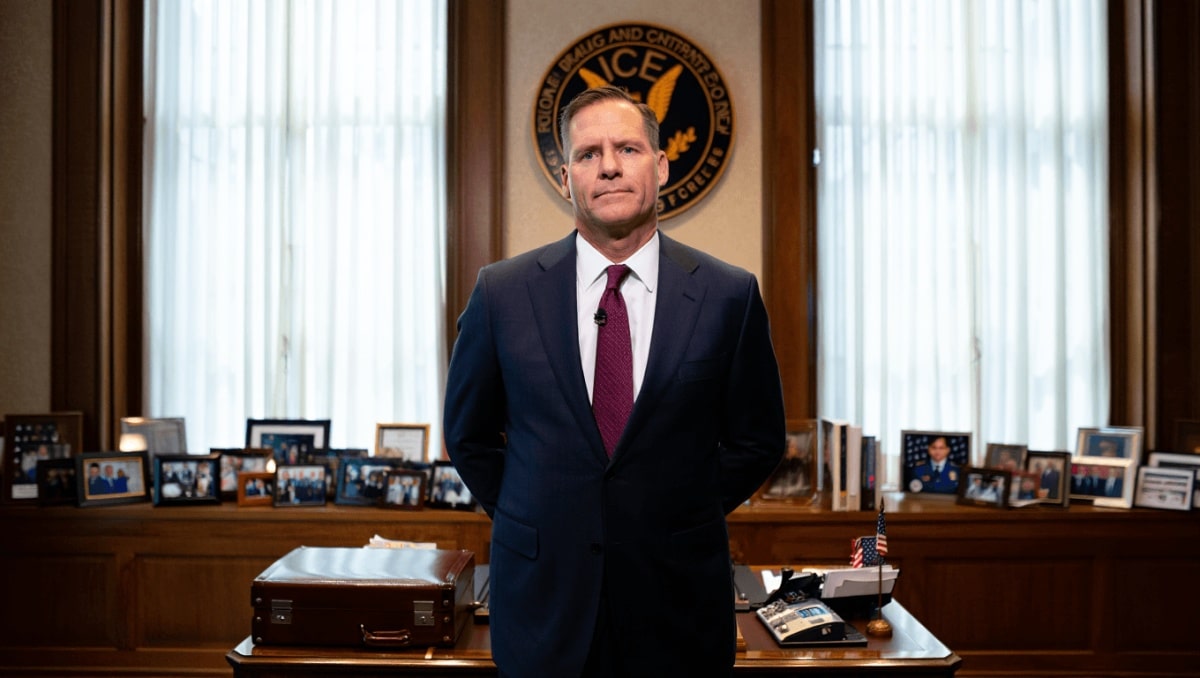
Todd Lyons, the acting director of Immigration and Customs Enforcement who helped carry out the administration’s expanded deportation strategy, will step down at the end of May, federal officials said Thursday. His departure — effective May 31 — leaves ICE with a leadership vacancy just as Congress has approved new resources for the agency and lawmakers press for tighter oversight.
Department of Homeland Security Secretary Markwayne Mullin confirmed Lyons’ resignation and praised his tenure, saying Lyons strengthened enforcement efforts and bolstered public safety. The department has not provided a public explanation for the departure beyond the secretary’s statement that Lyons will pursue opportunities in the private sector.
Lyons was named acting director in March 2025 and presided over a period of rapid expansion at ICE. In the past year, Congress granted additional funding that agency leaders used to broaden hiring, expand detention capacity and accelerate deportation operations.
Boxing champions ditch long runs for high-intensity training: new era in fight prep
Czech nationals among victims of Pinedale-area crash: two confirmed dead
Those deployments included high-profile enforcement actions in major cities, which drew intense scrutiny. Critics and some local officials complained about tactics used by federal officers during operations in places such as Chicago and Minneapolis, and the agency faced public backlash over alleged heavy-handed conduct.
Supporters in the administration framed Lyons’ record differently. Stephen Miller, the president’s deputy chief of staff and a principal architect of the administration’s immigration agenda, called Lyons a “dedicated leader.” A White House spokesperson posted on social media that Lyons had served the country well.
It remains uncertain who will replace Lyons. Whoever takes the role will inherit an agency that is both well-funded and politically contentious: Democrats in Congress are demanding new guardrails on enforcement practices as part of negotiations over restoring routine funding for the Department of Homeland Security.
On Thursday, Lyons and two other senior ICE officials testified before a House subcommittee to defend the agency’s budget request and its recent activities. Lawmakers pressed them on operational decisions and accountability, underscoring the sharp oversight attention ICE now faces.
The resignation comes amid a broader shake-up at DHS. President Trump recently removed former Secretary Kristi Noem; Mullin, who took over the department last month, has signaled he will continue key elements of the administration’s immigration policies while sometimes using a more measured tone.
Public sentiment toward the agency has been challenging. A February poll found that a majority of U.S. adults — including many independents — view ICE unfavorably, a political headwind that has intensified calls for reform and transparency.
Lyons also confronted uncomfortable questions in Congress about the agency’s role in two separate fatal shootings linked to enforcement activity. He declined to offer an apology on the House floor, saying he would not comment on ongoing investigations and that he had seen video related to one of the incidents but could not discuss it publicly.
Originally an enforcement agent in Texas, Lyons joined ICE in 2007 and rose through the agency before being tapped as acting director. His departure marks the end of a short but consequential stewardship during a period of accelerated enforcement and heightened political controversy.
- Budget and operations: Increased appropriations mean ICE can sustain expanded hiring and detention, shaping near-term enforcement capacity.
- Oversight and investigations: Congressional scrutiny and active probes into recent incidents may lead to policy changes or legal scrutiny.
- Community impact: Continued enforcement in urban areas could affect local policing relationships and immigrant communities’ interactions with authorities.
- Leadership transition: The incoming director’s approach will determine whether current priorities persist or are recalibrated.
What to watch next: who the administration selects to run ICE, whether Congress presses for statutory limits on enforcement, and the outcomes of the ongoing investigations that drew sharp questions at recent hearings. Those developments will shape enforcement practice and community consequences across the country in the months ahead.